Pitchampalyam Pudur, Tirupur – 641 603, Tamil Nadu, India +91-421-2472892 eswarioffice@eswariknitting.com

Facilities

Knitting, shrinkage control, dyeing, finishing, embroidery and garment making — with machinery from leading makers in Germany, Italy, Japan, Switzerland, the UK and the USA.

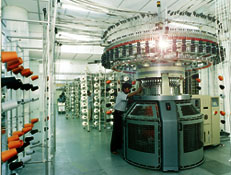
Circular knitting machine with yarn creel
01

Knitting Unit

Knitting plays a key role in this business. The result, quality and nature of the product are determined by the knitting machines, therefore we have invested in the best knitting machines of renowned make. Our knitting unit is one of the role models to all other knitting houses, equipped with high-ranked equipment.

Fabric types:

  • Single Jersey
  • Pique
  • Semi Jacquard
  • Interlock
  • Engineering Stripes
  • Full Jacquard
  • Wrapper

Machines: Falmac – Singapore · Mayer – Germany · Camber – UK

View machine details

Flat collar knitting machine
02

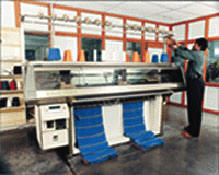
Collar Knitting Unit

Flat collar knitting machines for plain collars, and semi jacquard machines of Stoll – Germany and Kauoheng – Korea.

Overall production capacity: 3,500 kg of circular knitted fabric and 5,000 pcs of flat knit collars.

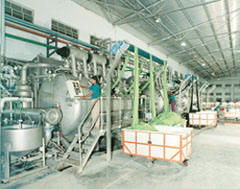
Soft-flow dyeing machines in the processing house
03

Processing Unit

Our in-house dyeing is done to international standards. This process house has state-of-the-art machines for yarn dyeing, fabric mercerising, fabric dyeing and finishing — Sperotto Rimar (Italy), Sclavos (Greece), Obem (Italy) and Santex (Switzerland) — with the latest equipment and processing facilities. The house has in-house water treatment and 100% recycling of wastewater.

We use the latest soft-flow dyeing machines, which maintain a consistent shade throughout the fabric, and we keep the production environment clean and hygienic. We use dyes that are free of AZO, agreeable to the regulation passed against forbidden dyes in Germany.

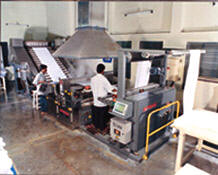
Fabric compacting machine
04

Compacting Unit

Shrinkage control, or compacting, is a mechanical shrinkage control process achieved by compacting machines imported from Tube-Tex – USA and Lafer – Italy (two machines). It keeps shrinkage below 5%, meeting all international standards.

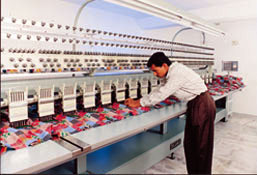
Operator at a multi-head embroidery machine
05

Embroidery Unit

Fabric, cut fabric, semi-stitched and fully stitched garments are embroidered according to pattern.

Be it a logo, chest or label, they can be embroidered on our in-house embroidery machine of 96 heads, with 6 to 12 colours each, from Tajima – Japan.

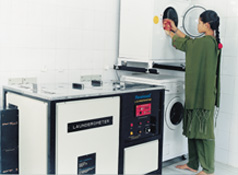
Technician testing fabric in the in-house laboratory
06

Laboratory & Quality Control Room

In our in-house laboratory, quality control is done in three stages for colour fastness, shrinkage and pilling:

  1. 1
    Finished fabricBefore going to production (cutting & stitching).
  2. 2
    Mid-productionCross-checking during production.
  3. 3
    Packed garmentsA few garments taken randomly from the finished, packed garments.
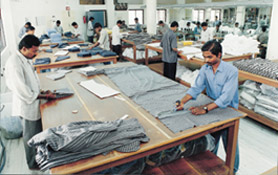
Cutting tables with fabric laid out and cutters at work
07

Cutting Section

Cutting a garment is an important factor, as it determines the fit of knitwear or any other clothing. Our cutting is done “perfectly”, keeping in mind the latest fashion fits. Eswari’s exclusive fits are ready to adorn the deserving, on and off the ramp.

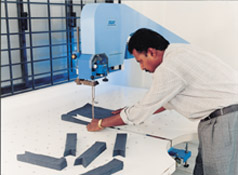
Cutting master using a band-knife cutting machine
08

Lay Cutting

The cutting room is handled both manually — for stripes and jacquards, to set the stripes and design at the side seam — and mechanically, i.e. lay cutting of KM cloth by a cutting master, to make consistent and sharp cuts.

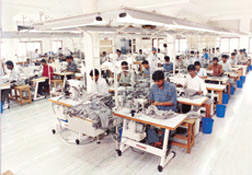
Garment stitching floor with rows of machines
09

Stitching Section

For stitching garments we have 200 machines. The overlock and flatlock machines are from Pegasus – Japan and the lockstitch machines are from Juki – Japan. All the machines are fitted with auto thread trimming and dust collection.

The machines are also fitted with top feed, which reduces the tension in seams. Special stitching such as decorative stitching, bartacking, buttonholes and buttoning is done by machines made by Juki – Japan.

Supervisors checking finished garments at inspection tables
10

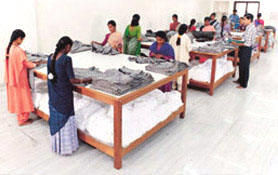
Checking Section

The finished garment is then subjected to a thorough check by skilled supervisors — even the smallest defect is not overlooked.

Garments being steam pressed at vacuum ironing tables
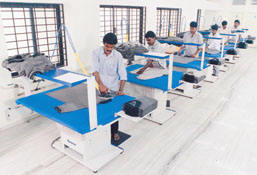
11

Ironing & Packing Section

Pressing is the last phase of garment production, and it is also done with the latest machines. The garments are steam pressed and vacuum sucked to take away any excess moisture caused by steaming. After pressing, the garment goes for final packing.

We also undertake job work: collar knitting, embroidery, compacting & raising.

Enquire about job work

Business enquiries

Send us your requirement and we will send the details as soon as possible.

Send an Enquiry